
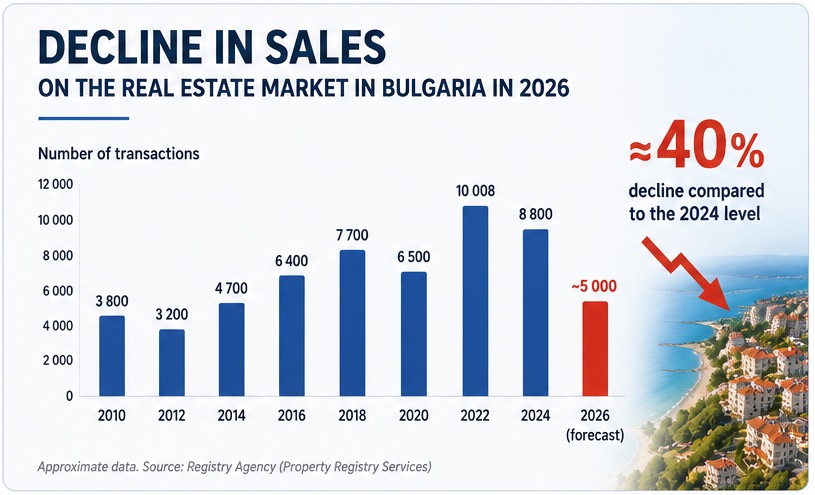
Here is an analysis from the experts at the Sherlock Holmes Bulgaria estate agency.
Following the official introduction of the euro in Bulgaria on 1 January 2026, many expected prices to rise further and the number of transactions to increase. However, the first half of the year has revealed a different trend: the market has entered a lull, with a noticeable decline in transactions.
Facts:
Looking at the entire history of observations (official statistics since 2005), we see that 2022 was almost a record year for the Bulgarian property market: prices rose at double-digit rates, and buyers were panic-buying flats ‘just in case’ ahead of the switch to the euro. Across the whole of 2022, exactly 10,008 transactions were registered in the Municipality of Nessebar. By way of comparison, the historical peak was in 2007, when the number of transactions was slightly higher – 10,084. Thus, 2022 and 2007 are the only years in which the figure of over 10,000 transactions was reached.
Interestingly, in terms of the number of transactions in 2022, the Municipality of Nesebar outperformed major cities such as Burgas, Ruse and Stara Zagora, and ranked second after Sofia, Plovdiv and Varna.
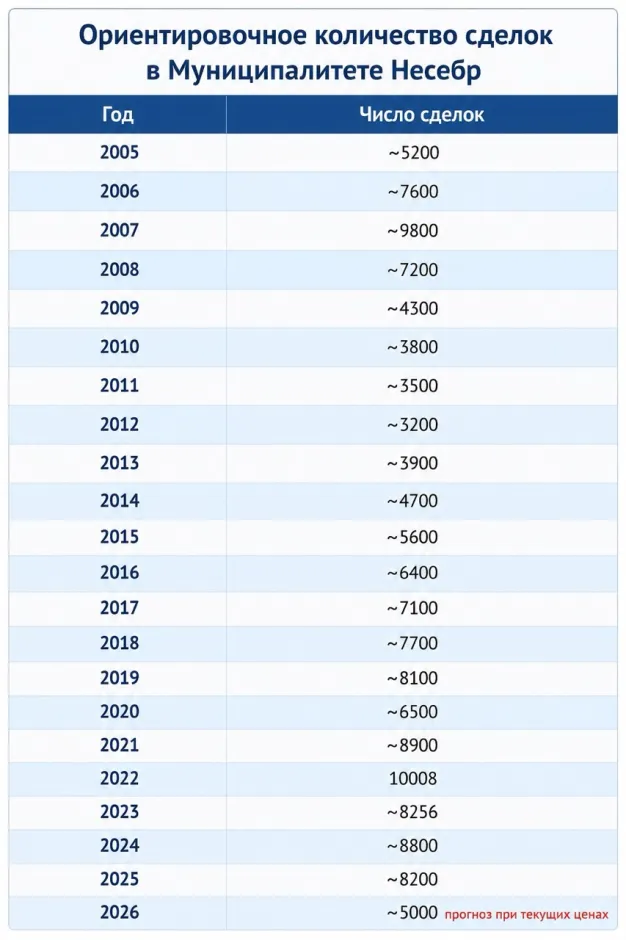
As can be seen, 2021–2024 were ‘overheated’ years, driven by abnormally strong demand in the wake of COVID and high foreign demand, primarily from Ukraine and Poland.
What is happening now?
Following Bulgaria’s entry into the eurozone, people have adopted a ‘wait-and-see’ approach. In 2025, there was a rush to “buy before the euro”, so part of the demand has already been met. The main change is that the psychological factor of “managing to buy before the euro is introduced”, as was the case in recent years, has disappeared. On top of that, sellers have raised prices en masse, and some are postponing sales, expecting prices to rise further (which is unlikely to happen). Currently, we are seeing a wait-and-see attitude among buyers, an adjustment of price expectations, and adaptation to pricing in euros within the country.
In fact, we have:
- fewer transactions,
- fewer buyers,
- almost no new building permits being issued except in the city of Burgas,
- yet prices are not falling.
In which areas have building permits for new developments been issued in 2026:
1 Burgas city
2 Sarafovo
3 Pomorie
Conclusion:
2026 has effectively become the first year following the ‘overheating’ phase, when sellers can no longer set any price and sell ‘within a week’. Factors such as the Schengen Area, the Eurozone, prices lower than those on the coast in Spain/Greece, and demand from Poland/Ukraine/Germany are currently supporting the market. However, the statistics show a return to 2014 levels.
